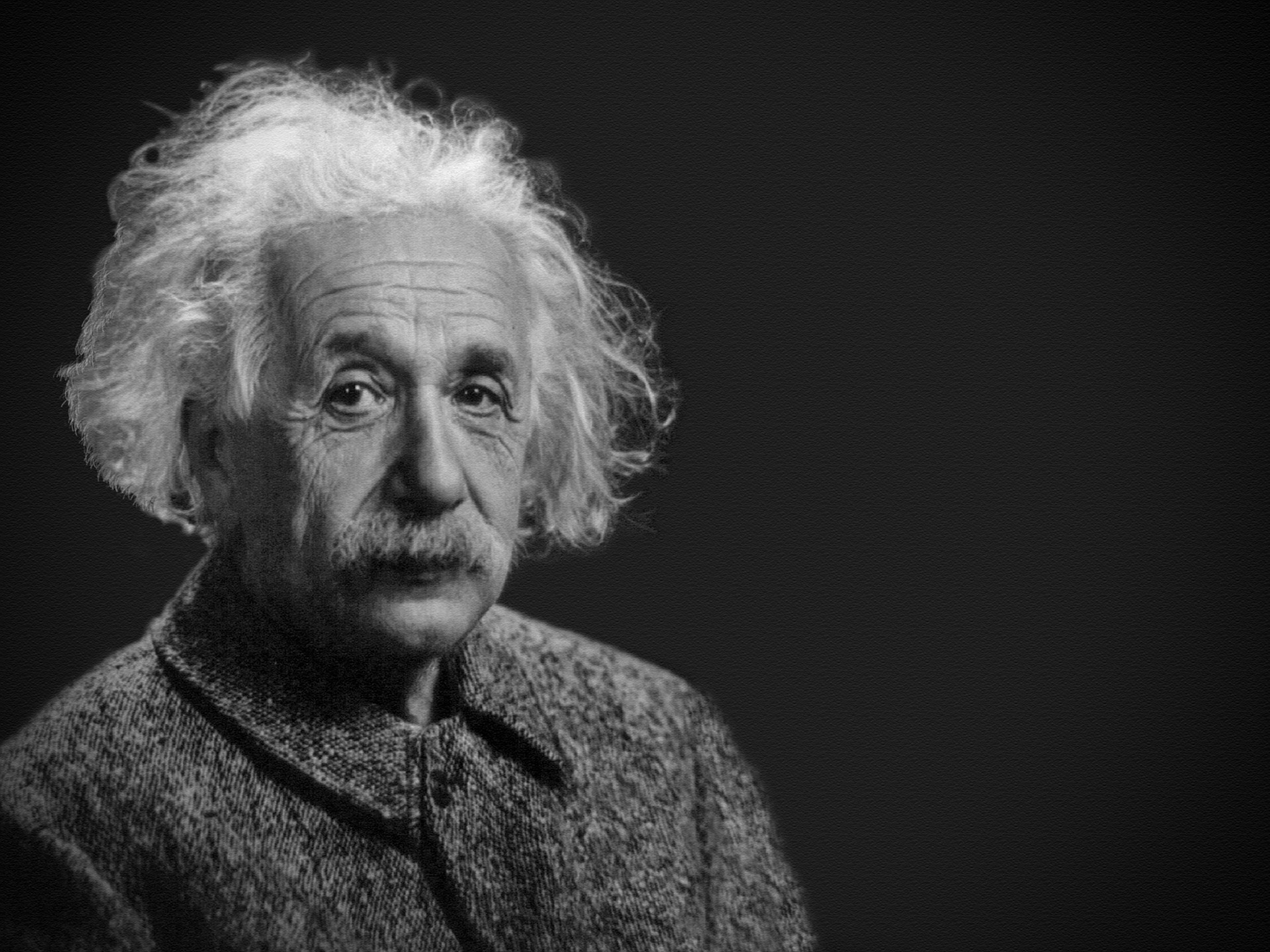
Albert Einstein (1879–1955) was a German-born theoretical physicist widely regarded as the most influential scientist of the 20th century. His history is defined by his revolutionary redefinition of space, time, and gravity, which shifted physics beyond Newtonian mechanics.
Scientific Contributions
His 1905 “annus mirabilis” (miracle year) saw him publish four revolutionary papers: on the photoelectric effect, Brownian motion (proving the existence of atoms), special relativity, and mass-energy equivalence (E=mc²)
- Theory of Relativity: He published the special theory of relativity in 1905 and the general theory of relativity in 1915, describing gravity as the curvature of spacetime.
- Mass-Energy Equivalence: He derived the famous equation E=mc2, establishing that mass and energy are interchangeable.
- Quantum Mechanics: He won the 1921 Nobel Prize in Physics for his discovery of the law of the photoelectric effect, a pivotal step in quantum theory.
- Other Discoveries: He provided theoretical evidence for Brownian motion (proving the existence of atoms) and predicted stimulated emission, the principle behind lasers.
Historical and Cultural Significance
- Global Fame: Einstein became the world’s first “celebrity scientist” after British astronomers verified his predictions of light bending during the 1919 solar eclipse.
- Nuclear Age: His work laid the theoretical foundation for nuclear energy; he later signed a letter to President Roosevelt urging the development of atomic weapons, a decision he deeply regretted.
- Humanitarian Efforts: A staunch pacifist and Zionist, he emigrated to the U.S. in 1933 to escape Nazi Germany, becoming a U.S. citizen in 1940 and advocating for civil rights and nuclear disarmament until his death in 1955.
Contribution Year Significance
Special Relativity 1905 Showed that space and time are interwoven; led to E=mc²
General Relativity 1915 Recast gravity as the curvature of spacetime; confirmed by the 1919 solar eclipse
Photoelectric Effect 1905 Laid groundwork for quantum mechanics; earned the 1921 Nobel Prize in Physics
Brownian Motion 1905 Provided theoretical proof for the existence of atoms
Stimulated Emission 1917 Predicted the principle behind lasers
Unified Field Theory 1920s–1950s Lifelong quest to reconcile gravity and electromagnetism; remained unfinished
https://www.biography.com/scientists/albert-einstein
https://www.space.com/15524-albert-einstein.html
https://www.ias.edu/albert-einstein-brief
Einstein’s connection to gravity research
To the relevance of Einstein’s role in researching gravity, there’s a prevalent question: what is gravity? Sir Isaac Newton established the principal laws of gravity 400 years ago. Albert Einstein originated his Theory of Relativity 100 years ago.
Following the question that asks what gravity is, here is the next question: Is gravity a product of mass or is it a product of subatomic motion?
Over the past 400 years, gravity has been affirmed to be a product of mass. Many scientific laws and discoveries are attributed to gravity. Long range space flights using gravity as a source of motion, have been calculated by mathematical formulations based on gravitational laws.
To alleviate a misconception regarding a new theory explaining what gravity is, it is not a suggestion that Newton was wrong. The new theory of gravity is simply an explanation of where gravity comes from. Newton’s gravitational laws explain what it does. Einstein’s General Theory of Relativity helped to explain what gravity is.
Although academia science teaches how to construct mathematical equations based on the principles of gravitational law, it does not define what gravity is. Science practices gravity as the accumulation of mass rather than being a product of subatomic motion. Conversely, the body of theoretical particle physics suggests gravity as a product of subatomic motion by its practice of smash and guess; and has chosen the orbital concepts of gravitons and gluons to represent gravity. The body of theoretical physics opinion still lacks a full explanation of what gravity is.
Theoretical physics
In theoretical physics, the search for small particle makeup is like a puzzle. How do the pieces fit together? And, what are the pieces? One of the fundamental aspects of theoretical particle physics is the ongoing questions that asks how things are stuck together and don’t fall apart?
Common sense and practicality are a necessary component for a hypothesis keeping subatomic particles to stay intact. Academia has assigned its name gluons and gravitons. Color, flavor, up and down are names assigned to provide an explanation to stationary positions of particle movement.
In conjunction with gravity, the primary analysis for motion is the accepted standard set over 100 years ago by Albert Einstein. His theory of relativity is certainly one of the most popular formulas of physics: E=MC2. The analysis of this formula is, predominantly, a limited perspective. The interpretation is most often assumed as a reference to energy. The formula is Einstein’s theory of relativity. What Einstein states, is his analysis of what relativity is. Perhaps his formula might be shown as R (for relativity) = E=MC2, or the Theory of Relativity is E=MC2. His theory of relativity is the claim that mass times the speed of light is a universal constant. Even more so to E=MC2, is that it has to be pointed out that the constant is Mass multiplied by the Speed of Light (MC). Energy is the square to the speed of light.
The importance of this is the interpretation of what the formula says regarding Mass at light speed. His theory makes the claim: our relativity shows that everything; all matter, is traveling through space at the speed of light. Light travels at 186,000 miles per second; times 186,000 per second, is even faster. The statement: energy equals mass times the speed of light squared says that the action of energy is an action that exceeds the non-perceived consistency of motion.
An example of this is to visualize standing on a moving train. Everything inside the train does not appear to be moving. And yet, it is.
Einstein’s theory of relativity makes the statement that all thing relative to our perspective is moving at light speed. By his interpretation of saying that energy is equal to mass times the speed of light squared, it says what we see as energy: is a force that is twice the speed of light. So, that means: really fast. It also means even though we’re moving at light-speed, we’re unable to see electricity move.
Additionally, Einstein’s mathematical statement applies to all physics. Literally, it means that all laws of physics are fundamentally incorrect. To clarify: it’s like the example of standing on a train, everything is the same but, the entire platform of the Milky Way Galaxy is moving. This is a fundamental change, or a patterned inconsistency to the basis of current scientific perception.
Leave a Reply