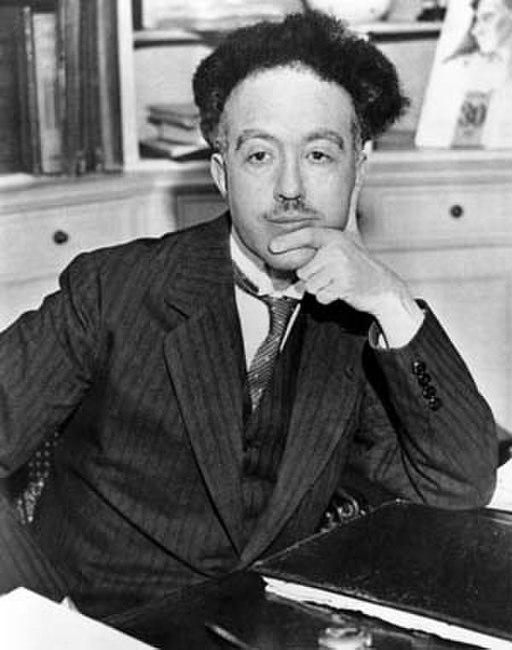
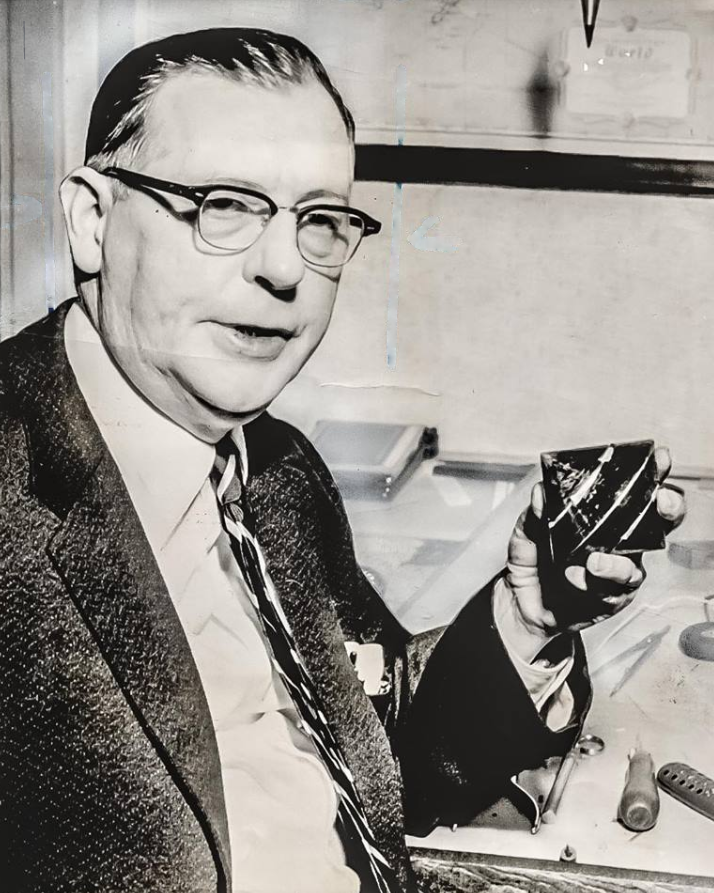
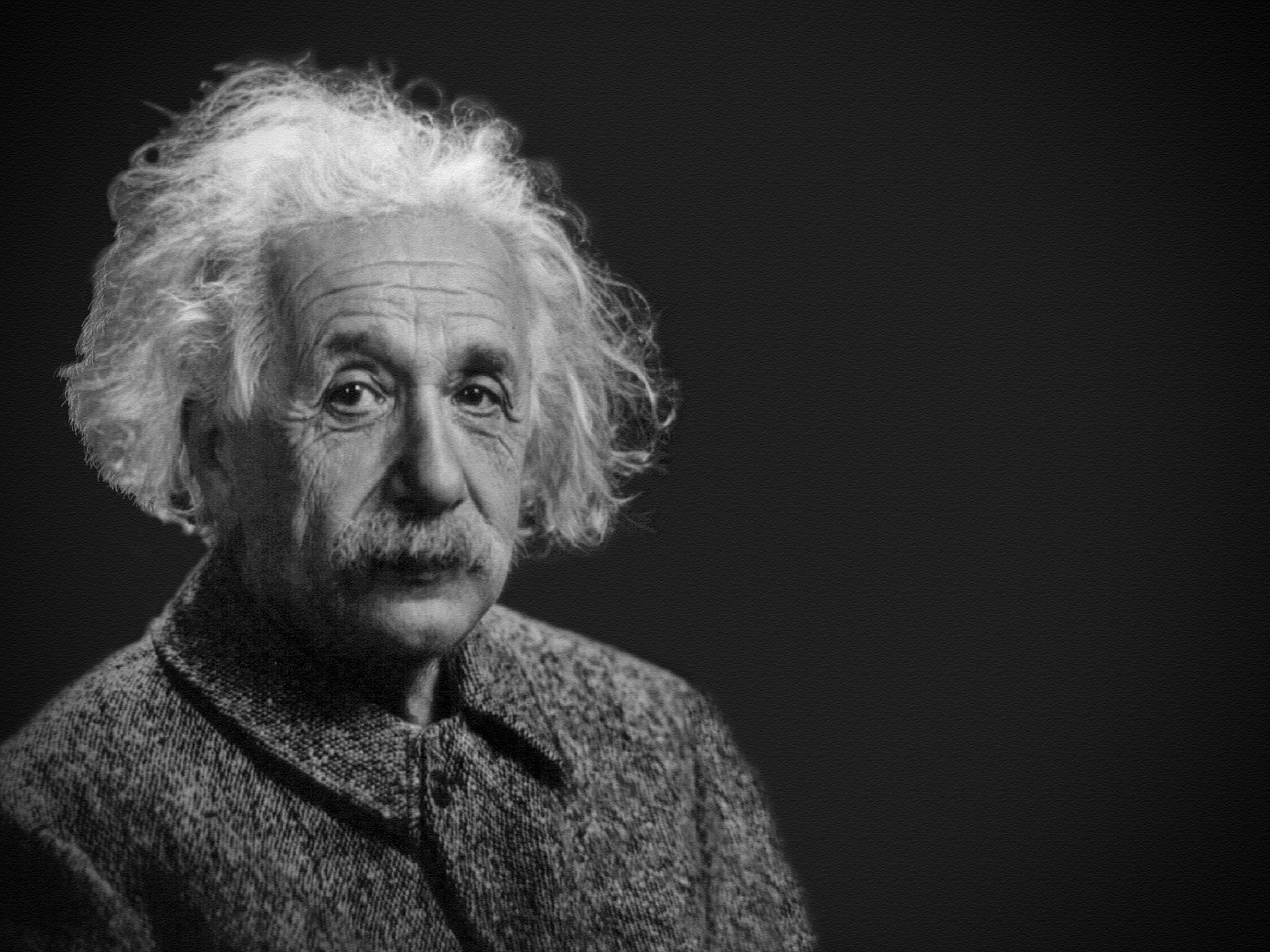
In 1924 his thesis for discovering the wave character of matter was awarded the Nobel prize.
Louis de Broglie’s most famous contribution to physics is the de Broglie hypothesis (also called matter waves), proposed in his 1924 PhD thesis Recherches sur la théorie des quanta. It states that all matter has wave-like properties, with a wavelength given by λ = h/p (where h is Planck’s constant and p is momentum). This extended the wave-particle duality of light to material particles like electrons, laying the foundation for wave mechanics and quantum mechanics.
The hypothesis was experimentally confirmed in 1927 by the Davisson–Germer experiment, and de Broglie was awarded the 1929 Nobel Prize in Physics “for his discovery of the wave nature of electrons.”
The best summary about the life of Louis de Broglie and the development of his career which led to his discovery that led to him receiving the Noble Prize in physics is at Britannica.com. The article details his life and how he discovered wave duality.
The CATTCC article titled: de Broglie waves, describes these wave principles.
In another CATTCC article is a paragraph title, Levitating vehicle; which asks a relevant question: What are all the possible aspects involved with levitation? First is electromagnetics. Then, electrogravitics, gravitational influence, psychokinetics, vacuums, CSEs, crystals, polymerization, the Schumann resonance, magnetosphere, ions, chitin, de Broglie waves, mass frequency vibration, dimensional transfer and then whatever else can be found.
Included in the article is a reference to de Broglie waves. What makes de Broglie waves important in theoretical physics is wave duality: the patterning of subatomic wave motion. Again, a reference to the same article is a quote from a collaboration between Viktor Grebennikov and Valery Zolotariov, PhD, about the relationship of the Cavity Structures Effect (CSE) and living systems; “… in which de Broglie waves associated with motion of electron flows in the solid walls of cavities create…”.
The de Broglie waves are universal; they are not isolated nor unique.
A very interesting note at the end of the Britannica article about Louis de Broglie, all of his life’s work brought a similar conclusion as Julian Schwinger: For about three decades after his work of 1923, de Broglie held the view that underlying causes could not be delineated in a final sense, but, with the passing of time, he returned to his earlier belief that the statistical theories hide “a completely determined and ascertainable reality behind variables which elude our experimental techniques.”
His determination; that particles behave in a manner which eludes experimental techniques, corresponds to this new theory which postulates gravity as the angular momentum of particle mass as it rotates along its linear path at light speed.
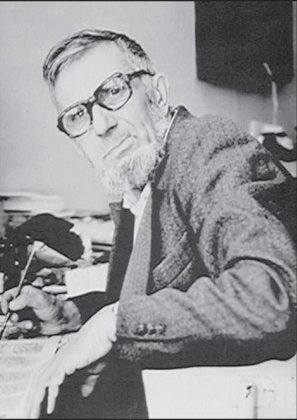
Viktor Stepanovich Grebennikov (1927-2001) worked as an entomologist at the Research Institute of Soil Management and Chemicalization of Agriculture in Krasnoobsk, Russia. He was a naturalist and scientist, artist and writer.
His research as an entomologist led him to discover unique characteristics in certain bugs. The discovery found that the chitin in specific types of insects are constructed with these unique cavity structures. Some of these designs emit a Cavity’s Structures Effect (CSE). These CSE’s provide communication and navigational senses for insects and can cause human physiological reactions.
In 1976, he founded the Museum of Agroecology and Environmental Protection.
In 1984, Viktor Grebennikov first published his discovery of the Cavity Structural Effect (CSE) in the Siberian Bulletin of Agricultural Science.
In 1995 he was granted a Russian patent in for a device containing beehive cells (dry honeycomb) for enhancing the effectiveness of therapeutic drugs in a patient. Use: in medicine to relieve pain in the human body. The essence of the invention: the device contains a source of therapeutic effect in the form of a set of superimposed frames filled with empty honeycombs, which are layers of a cellular structure. The device may comprise a rigid body fastened to the post and capable of movement along it, as well as needle displacement, in particular for setting the planes of the layers perpendicular to the direction towards the sun by means of a U-shaped bracket and hinges 4 zp f-ly, 4 ill.
The primary significance for adding Viktor Grebennikov’s name as a source of research is his discovery and potential of CSEs. In 1988 Grebennikov built a levitating platform, and began a written account of his invention with his discovery of chitin shell potential. His writings detailed his flying experiences over the Russian countryside and secret flights. In the first part of his writings, he acknowledged his fear that going public with this discovery would cause the theft of his discovery and his demise. His intended secrecy provided skeptics with an outlet to claim that Grebennikov’s levitating device never existed.
Shortly after his death, the written details in his book: ‘My Journey’ began surfacing and have become a popular source of intrigue.
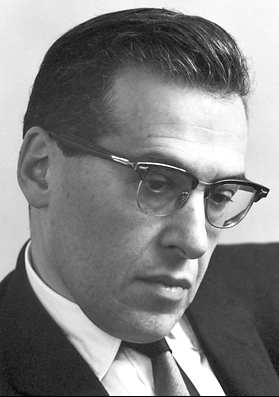
Julian Seymour Schwinger, February 12, 1918 – July 16, 1994.[He was born and raised in New York City and received his PhD in physics at the age of 21. His intense interest of physics and mathematics lead to a highly acclaimed career in theoretical physics. In 1965 he shared the Nobel Prize in Physics with Richard Feynman and Shin’ichirō Tomonaga for their fundamental work in quantum electrodynamics (QED).
Beyond being a physics professor at Harvard Univ, from 1945 to 1974, and from 1972 to 1988 at UCLA, he’s responsible for much of modern quantum field theory. He developed the first electroweak model, the variational approach, the perturbation theory, the equations of motion for quantum fields. the theory of multiple neutrinos, the first example of confinement in 1+1 dimensions, and the theory of the spin-3/2 field.
Schwinger and Feynman
(Content from Wikipedia) As a famous physicist, Schwinger was often compared to another legendary physicist of his generation, Richard Feynman. Schwinger was more formally inclined and favored symbolic manipulations in quantum field theory. He worked with local field operators, and found relations between them, and he felt that physicists should understand the algebra of local fields, no matter how paradoxical it was. By contrast, Feynman was more intuitive, believing that the physics could be extracted entirely from the Feynman diagrams, which gave a particle picture. Schwinger commented on Feynman diagrams in the following way,
Like the silicon chips of more recent years, the Feynman diagram was bringing computation to the masses.[19][20]
Schwinger disliked Feynman diagrams because he felt that they made the student focus on the particles and forget about local fields, which in his view inhibited understanding. He went so far as to ban them altogether from his class, although he understood them perfectly well. The true difference is however deeper, and it was expressed by Schwinger in the following passage,
Eventually, these ideas led to Lagrangian or action formulations of quantum mechanics, appearing in two distinct but related forms, which I distinguish as differential and integral. The latter, spearheaded by Feynman has had all the press coverage, but I continue to believe that the differential viewpoint is more general, more elegant, more useful.[21]
Despite sharing the Nobel Prize, Schwinger and Feynman had a different approach to quantum electrodynamics and to quantum field theory in general. Feynman used a regulator, while Schwinger was able to formally renormalize to one loop without an explicit regulator. Schwinger believed in the formalism of local fields, while Feynman had faith in the particle paths. They followed each other’s work closely, and each respected the other. On Feynman’s death, Schwinger described him as
An honest man, the outstanding intuitionist of our age, and a prime example of what may lie in store for anyone who dares to follow the beat of a different drum.[22]
Another short excerpt from a Wikipedia article goes into great detail about his quantum action principle;
In Schwinger’s approach, the action principle is targeted towards quantum mechanics. The action becomes a quantum action, i.e. an operator.S Although it is superficially different from the path integral formulation where the action is a classical function, the modern formulation of the two formalisms are identical.[4]
Julian Schwinger developed Source Theory in 1966 as a “phenomenological” alternative to standard quantum field theory (phenomenology: a philosophical movement that describes the formal structure of the object’s awareness and of awareness itself, in abstraction from any claims concerning existence). This line of reasoning became a major part of Schwinger’s work. His approach to describe particle actions expanded into the unexplainable. His Source Theory uses mathematical statements regarding strong interactions without the divergences and renormalization issues of operator-based approaches. His theory proposes “quantum fields as long-distance phenomena and uses auxiliary sources to abstract the creation and annihilation of particles, allowing for calculations that are mathematically consistent and free from infinities.”
From one of the Wikipedia links: Despite its conceptual clarity and ability to derive results like the Casimir effect without zero-point energy, Source Theory failed to gain widespread acceptance. Critics, including colleagues at Harvard, viewed it as an unnecessary complication or a mere pedagogical variant of existing field theories, leading Schwinger to leave Harvard for UCLA in 1972. His three-volume exposition, Particles, Sources, and Fields, remains a comprehensive but largely isolated contribution to theoretical physics.
Schwinger’s work grew from the conformity of opinion amongst academia’s greatest physicists, to the definition of his Renormalization Theory: the replacement of theoretically infinite variables (such as the mass and charge of an electron) with experimentally obtained values in the solutions of equations in certain quantum mechanical theories (such as quantum electrodynamics).
It’s like saying spending his entire life, exploring and calculating the minute details of splitting atoms, there was something more to the reactions.
There is simplicity in nature. Schwinger’s Source Theory holds more than what is academically popular.
Telling the story of his personal life, his life could serve as a script for a Lifetime Channel traumatic drama movie. Through it all, John Searl was a brilliant scientist. His place was in the lab amongst those searching for scientific answers to how nature moves, rather than holding a position of authority in the school of regulated academia opinion. Like Viktor Schauberger, he understood that the science of opposing nature uses explosions and destruction. Centrifugal force pushes with catastrophic strength, its propulsion in transportation pushes against nature, Mr. Searl’s efforts were set to move with nature.
Nature’s motion is centripetal
Nature is consistent. It has order; which makes it predictable. Nature follows a pattern; a flow of frequencies found at every level. Observing these patterns allows the use of these movements to create synergy.
The concept of building a device using a specific measure of magnetic quantities, has the simplicity of molecular symmetry in nature’s motion. This was the science John Searl spent his life seeking.
In the video: https://www.youtube.com/watch?v=zZ8KVzDeYaI John Searl discusses his findings of magnetics. The video is particularly intriguing as he talks about the spin of electrons based on the law of squares. His 60+ years of study, research, and building the devices based on his finding are completely different than the status-quo of contemporary scientific academia.
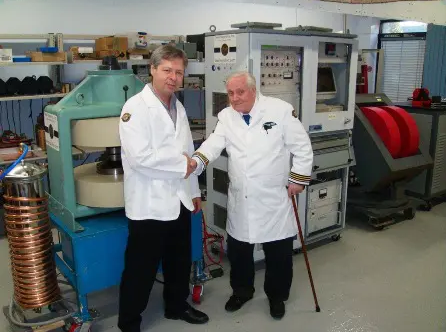
He describes his work in quantum mechanics as the study of the relationship between energy and matter. This includes the relationship between photons and electrons. His Searl Effect Generator produces electricity without friction, with no noise, no vibration, no heat, and no pollution.
The Searl Effect Generator operates on the principle of using an exact amount of molecular mass with their specific elemental atomic weight in a layered formation. The rollers and rings provide a reservoir, a gate, magnetic, and emitter. Every square represents a quantity of material. The key to the generator producing electricity is electrons and magnetic fields.
In building a generator, either the magnetic field rotates or the conductor rotates. In the Searl Effect Generator, the magnets are aligned at right angles to each other, both the roller and the plates have independent magnetic fields. One vertical, the other radial from the center to the rim. The intersection of these fields produces a wave that carries the roller around the ring.
The Searl Effect is the intersection of two magnetic fields creating a magnetic wave that can be measured and amplified. The Searl Effect Generator (SEG) uses magnetic fields to induce a flow of electrons from a rare earth element through a system of rotating magnetized components so that those electrons can be collected, compressed, used and recycled. The compression is in the creation of a magnetic field on the plate. The roller literally flies around the plate surface without physical contact.
As a result of John Searl’s early work, he found that the high voltage and magnetic effect produced levitating capability. He named this a Gyro-flywheel high energy-density mechanical magnetic device, which he renamed: The Levity Disc. With high pressure pushing down upon the SEG, it essentially overloads and produces extremely high voltage. This causes the device to become extremely cold and negatively interacts with Earth’s gravitational field. As its reaction, the device is then subject to ether and at zero-point energy. It then is capable of flight.
This raises another question about UFO sightings, never mentioning cold air.
Levity Disc
The Levity Disc is more obscure than the SEG. The task of CATTCC is its pursuit of transportation. As it is one of the pursuits in designing an efficient transportation device; thermodynamic loss is like an intolerant cuss word. Thermodynamic action is seen in the Levity Disc as compressed air surrounding the device.
In his paper on Searl Technology, Julio Gobbi describes the operational concept of John Searl’s Levity Disc. “It is based on the atmospheric pressure gradient caused by the air ionization around the device as a result of the high-voltage electrostatic field developed between the plates and the periphery of the device. The movement and separation of atmospheric electrostatic charges caused by the translation and rotation of the rollers provides a low-pressure envelope that can be used for thrust.”
He then goes on to say: “The magnetic propulsion system works by the principle of controlling the force of the terrestrial gravitational field through the repulsion between the magnetic field created in the center of the equipment and the vertical component of the terrestrial magnetic field.” In a simple way, Gobbi explains that the magnetic field generated in the center of the equipment will react as attraction or repulsion with the terrestrial magnetic field; as a relational component of the device’s weight.
John Searl provided phenomenal insight for the advancement of magnetic motion.
Looking into the life of Otis Carr, has an ending that’s the definition of tragedy.
In his 20s, Otis Carr worked at the Hotel New Yorker. When he was 30, Nikola Tesla moved his residence there. The two became friends and Otis Carr became Tesla’s protégé.
The late 1800s and early 1900s held remarkable advances for science. WWI and WWII proliferated atomic research. All scientific research was on the leading edge of discovery. By the 1950s, scientific research became compartmentalized and segmented by academia practice. Fringe scientific research became politicized. The study of gravity and field of electrogravitics became political. The scientific community rendered T. Townsend Brown into the same “crackpot” class as Nikola Tesla. Electrogravitics suffered a knock-out blow. During this same time, as the aeronautics industry flourished; the study of gravity and electrogravitics disappeared.
In the late 1950s, the fleeting fringe science leader was hit with a death blow that killed the entire fringe science industry.
No one else in the aeronautics industry could make the claim of inertia negation and “telepathic” control operations that Otis Carr claimed; it was considered preposterous. Disbelief was easier to understand, and disgrace was Otis Carr’s outcome.
Otis Carr built a transportation device so advanced, no one understands how it works. For his effort, he was charged with a $50,000 fraud claim by the SEC in 1960 and given a 14-year jail sentence. His lab and equipment were seized, everyone whom worked with him was told to never discuss it.
Back to the science of electrogravitics and building a craft operated by some type of telekinesis. Otis Carr’s, protégé to Nicola Tesla, is said to have built a craft which transports people by a variation of dimensional alteration. My interpretation of his technology is by speed variation of light frequency. This could be interpreted as a spiritual plane or, at least a dimensional shift, or dimensional transition; to operate the vehicle. Literally this means operating a traveling vehicle with wave patterns to a frequency response fixed on the operator’s thought waves. The technology is similar to vocal controls of audio-controlled switching with specific frequency tone response to the speed of light variance.
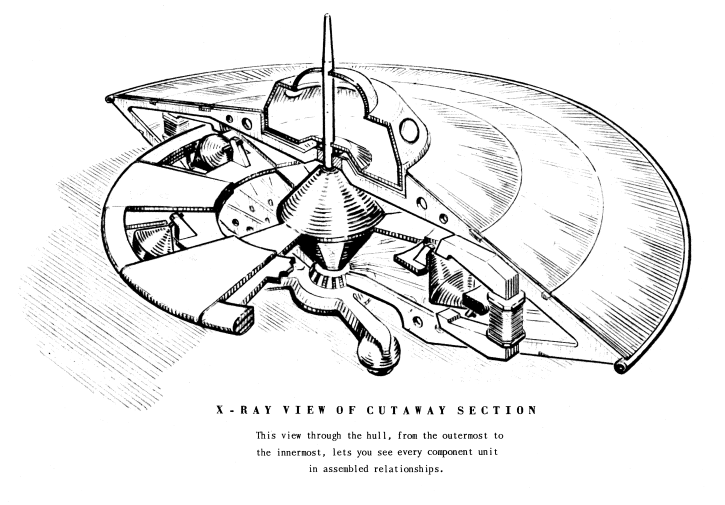
There is a consistent design image whenever there is a description or drawing of a flying saucer. All the pictures match the design specification to what both Otis Carr’s and John Searl’s designs and alleged builds looked like. Otis Carr’s design is available in the public domain.
The concept of a spinning disc, using principles of electrogravitics with designs by Carr and Searl; a craft as a spinning disc in a straight line on a horizontal plane, would be less effective at significant speed; than following a path on a very specific rotational linear pattern traveling through space. This linear pattern path is similar to the path of particle mass.
In the endeavor to explain transportation’s future, how it floats and the source of movement by gravitational force, Otis Carr’s design presents engineering concepts of how the future of transportation can travel.
The Biefeld-Brown Effect finds that when the leading edge of a highly charged capacitor is positively charged and its trailing edge is negatively charged, a freely suspended capacitor will have forward thrust in the direction of the positive charge. This grants insight into understanding the opportunity to straddle gravitational waves for a craft’s-controlled movement. As in the example of Otis Carr’s design, the freely suspended capacitor is located inside, at the center of the vehicle.
It is imperative for society to now consider new methodologies of transportation technology.
In 2006 an interview revealed spectacular information regarding Otis Carr’s craft, from a technician who’d worked closely with Otis Carr in building his transportation device. In the interview, Ralph Ring said the following:
“The Utron was the key to it all. Carr said it accumulated energy because of its shape, and focused it, and also responded to our conscious intentions. When we operated the machine, we didn’t work any controls. We went into a kind of meditative state and all three of us focused our intentions on the effect we wanted to achieve. It sounds ridiculous, I know. But that’s what we did, and that’s what worked. Carr had tapped into some principle which is not understood, in which consciousness melds with engineering to create an effect. You can’t write that into equations. I have no idea how he knew it would work. But it did…”
“…there are two secrets to making the alien saucers work. One is their advanced engineering, and the other is their mental ability.
“I’ve lost count of the number of people who have refused to believe what happened. I no longer talk about it. It’s no fun being laughed at and ridiculed. But I’ve described it exactly as it occurred. One day someone will build the disk just as we did and they’ll have the same experience. All his blueprints still exist. Nowadays, it would all be done with digital and solid-state circuitry – no moving parts would be necessary.”
In an interview from the 1950s, Otis Carr said the following:
“Any vehicle accelerated to an axis rotation relative to its attractive inertial mass, immediately becomes activated by free-space-energy and acts as an independent force… We have shown that a charged body, accelerated to an axis rotation relative to this attractive inertial mass, indicates polarity in a given direction.
“The dip-needle points, say, up toward the top of the body. But mount this while rotating body, with its spindle, on another platform and rotate this platform on a spindle, then if the counter-rotation is greater than the inertial forward rotation of the body, a dip-needle on the second platform will point down while the first dip-needle points up, indicating complete relativity of polarity. When the exact counter-rotation matches the forward rotation, the body loses its polarity entirely and immediately becomes activated by free-energy (tensor stresses in space) and acts as an independent force. The above-described assembly of counter-rotating charged masses becomes weightless and will escape the immediate attraction of gravitational forces.
The point to what he is talking about has to do with gravity generators. For the sake of this writing, it has to be noted that according to the scientific community, energy generators powered by gravity don’t exist. Although John Searl is also said to have invented and built one. And, the principle follows the Biefeld-Brown Effect of electrogravitics.
From the 2006 interview with Ralph Ring, he goes into more detail regarding the mechanics of Otis Carr’s craft.
The interviewer:
“The source of power for the craft was magnetic in nature? How did the craft work?”
Ralph Ring:
“In those days we had counter-rotating wheels, one going clockwise and another going the counterclockwise. We had a capacitor. We had small magnets. And, we had what’s called a Utron (note Utron Electrical Accumulator), it’s a double tetrahedron (that’s two ice-cream cone shapes) put with the open ends together so that you have a diamond shape. And, we had 12 of them around the periphery of the craft. And, we had horseshoe magnets, 12 of those around the craft. So, when you started rotating and counter-rotating, you have the Utrons; as they went through these fields, they would act as a generator, and a capacitor in themselves, and they would generate a lot of power. Not necessarily electrical power: vibrational power.
“When you get to the resonant frequency of your surroundings, it cancels everything out. It goes to a zero point. Once you’ve reached zero point, then you can go anywhere you want. And, you have your own force field around the craft.”
In building a transportation device, Ralph Ring was very specific in making the distinction to referrer to the craft he worked on, deliberately refraining from the term: “flying”. It levitated and transported; it didn’t fly.
Here is another important question. If Otis Carr had the technology and built this apparatus in 1959, where are the garages and warehouses to build this type of technology today? 60 years later and intellectual capacity no longer exists to replicate this type of device?
The interview continues with Ralph Ring:
Interviewer:
“You control its up and down and left and right movements by how fast it spins, or other gyros in there?”
Ralph Ring:
“Yeah, the ones with the models, we had remotes, you know, to operate the models but, when you get up into the larger craft, it’s not necessary because everything then, as Carr was explaining the difference between the brain and the mind is synergetic. You operate the craft like it was a friend. It’s like it was a living thing because that’s the only way that our particular craft would work there.
Interviewer:
“Was a mental interface?”
Ralph Ring:
“Yes”
Interviewer:
“It’s like our thoughts carry out a vibration as well and you have to go in harmony with the ship. So some sort of morphogenetic field was created. Perhaps some sort of almost living feel.”
Ralph Ring:
“Absolutely.”
In his explanation of travel, Mr. Ring describes that the craft teleports through time and space. The craft traverses through multi-dimensions.
In building Otis Carr’s device there is a lot of speculation with a limited amount of information. So many unknowns provide a lot of consideration.
Again, Nikola Tesla was brilliant. His inventions were not understood in his day, some of his inventions are beyond today’s science. Having said this, there is something to be learned from the flying disc of Otis Carr, Tesla’s protégé. What mechanism provided the craft to levitate? How did the non-mechanical Utron control mechanism work? Where is the device of Otis Carr’s that was removed from his lab 60 years ago? What became of his work and technology?
The answer to where Otis Carr’s flying disc, and the products of his efforts and designs are; is the speculation that stimulates conspiracies. In the early 1960s, the press releases relating to anything regarding Otis Carr were announcements from sources with claims he was a fraud. By a few anonymous loud voices, this campaign of negative press relations remains tagged to the entire field of science known as electrogravitics. Science taught the world is flat, thus; if you take a vacation on a cruise ship there is a likelihood you’ll never return. Even today, Wikipedia attacks the legitimacy of electrogravitics from being a plausible science. At the same time, advanced academia has accepted the science of spintronics with its new application towards quantum computing, 100 years after its discovery. There is no rational in the acceptance to an entire new field of science and dispute the credibility of its history.
In searching transportation solutions for sustainability, some fields of science should be reconsidered and more thoroughly explored.
Let’s take a closer look at Otis Carr’s design. Mr. Ring, the technician working on Carr’s project, spoke at a conference several years ago, said the flying disc flew using the Utron as its power source. And, he also said the Utron accumulated energy because of its shape, and focused it. Was the crystal globe device part of the thought control mechanism for piloting the craft?
It seems the double tetrahedron spoken of, is the Utron. The two tetrahedrons are placed opposite each other forming a diamond shape. What isn’t disclosed is its composition. Dependent upon how it’s viewed, it looks like a tetrahedron on top of an inverted tetrahedron, a square, a circle or a pyramid; it’s referred to as a platonic solid. The frequency generated by this is unique. The u-shaped horseshoe magnets pass over these Utrons and accumulate energy. So the globe might be used as a frequency amplifier, or would the Utron be the amplifier?
The battery apparatus has to supply power to both rotating discs. Otis Carr’s flying disc uses an “accumulator” as a function of its battery’s regenerative ability. How does that work? The Utron is the accumulator. There are 12 sets of matching instruments which generate energy as the device spins. As the housing portions of the horseshoe shaped magnetic Utron device rotates, it collects energy from the Utrons and causes spin.
According to the mechanics of Otis Carr’s device, the device creates spin frequency. As evidenced by the interview of the craft’s flight crew member, it can be concluded that the craft’s spin generated the craft into its own inertia field. Speculatively, in addition to this independent inertial field, it could be proposed the aquamarine frequency was the source of an entry point to dimensional access. The concept being that the aqua-marine frequency is a particular color of light with a very specific frequency.
As a multigenerational Master Forester, there is undoubtedly no greater authority for sustainability than Viktor Schauberger. He lived his life studying nature. One of his most relevant discoveries to transportation is understanding of subatomic physics in nature and the clarification of efficient energy.
The significance to this clarification in nature is that it moves in centripetal motion. With all chemical and nuclear combustion being centrifugal, it is destructive in its movement. A sustainable energy source requires centripetal motion.
One of Viktor Schauberger’s most compelling efforts was being forced to work with Nazi technological advances in the late 1930s. During these years of his life, during the period prior to and during WWII, he was unwillingly recruited to work for the Nazis. He worked to develop the Repulsin A & B.
His work led him to say the following: “If water or air is rotated into a twisting form of oscillation known as ‘colloidal’, a buildup of energy results, which, with immense power, can cause levitation. This form of movement is able to carry with it its own means of power generation. This principle leads logically to its application in the design of the ideal airplane or submarine… requiring almost no motive power.”
The important point to transportation is: centrifugal motion is a pushing force it causes massive amounts of friction. The nature of an explosion is that the subatomic action releases its energy in 360 directions. This action causes massive friction. The action also provokes a tremendous amount of heat. The heat causes expansion which generates more heat.
Heat is extremely advantageous in winter. Extreme temperatures of an explosion are not necessarily advantageous for efficient transportation. What Mr. Schauberger did was to discover the significance of centripetal motion. All nature is centripetal. The significance of this for transportation is he designed an impeller that is operational to a vortex. To explain this: it means centripetal motion creates a vacuum. There is no friction. This is a model to create high efficiencies of energy for transportation.
Mr. Schauberger’s Repulsin craft used this impeller spin design and it crashed into the roof of the building. Although this design was tremendously successful, its success was poorly timed. The event of testing was near Germany’s collapse, and the project was reassigned to aeronautic engineers. Aeronautics is a totally different field of scientific philosophy. A control mechanism for the Repulsin was never completed.
This technology is clearly vital to advance transportation technology.
The links for Viktor Schauberger vary in the disciplines he practiced. As a highlight to who he was, there are several highly significant discoveries he established regarding the use of gravity for transportation. Although his discoveries weren’t directly related to gravity or transportation, his observation of nature is.
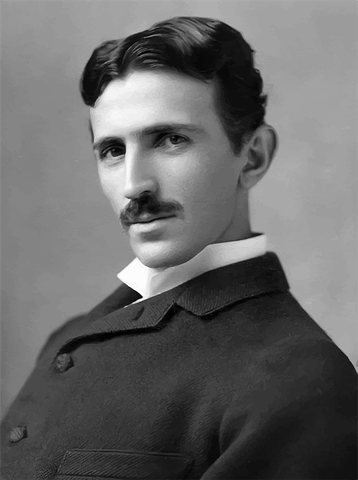
Nikola Tesla (28 June 1856 – 7 January 1943) was a Serbian-American inventor, electrical engineer, mechanical engineer, and futurist best known for his contributions to the design of the modern alternating current (AC) electricity supply system and much of modern technology.
From History.com: Serbian-American engineer and physicist Nikola Tesla made dozens of breakthroughs in the production, transmission and application of electric power. He invented the first alternating current (AC) motor and developed AC generation and transmission technology. Though he was famous and respected, he was never able to translate his copious inventions into long-term financial success—unlike his early employer and chief rival, Thomas Edison.
Nikola Tesla’s Early Years
Nikola Tesla was born in 1856 in Smiljan, Croatia, then part of the Austro-Hungarian Empire. His father was a priest in the Serbian Orthodox church and his mother managed the family’s farm. In 1863 Tesla’s brother Daniel was killed in a riding accident. The shock of the loss unsettled the 7-year-old Tesla, who reported seeing visions—the first signs of his lifelong mental illnesses.
Tesla studied math and physics at the Technical University of Graz and philosophy at the University of Prague. In 1882, while on a walk, he came up with the idea for a brushless AC motor, making the first sketches of its rotating electromagnets in the sand of the path. Later that year he moved to Paris and got a job repairing direct current (DC) power plants with the Continental Edison Company. Two years later he immigrated to the United States.
Nikola Tesla and Thomas Edison
Tesla arrived inNew Yorkin 1884 and was hired as an engineer at Thomas Edison’s Manhattan headquarters. He worked there for a year, impressing Edison with his diligence and ingenuity. At one point Edison told Tesla he would pay $50,000 for an improved design for his DC dynamos. After months of experimentation, Tesla presented a solution and asked for the money. Edison demurred, saying, “Tesla, you don’t understand our American humor.” Tesla quit soon after.
Nikola Tesla and Westinghouse
After an unsuccessful attempt to start his own Tesla Electric Light Company and a stint digging ditches for $2 a day, Tesla found backers to support his research into alternating current. In 1887 and 1888 he was granted more than 30 patents for his inventions and invited to address the American Institute of Electrical Engineers on his work. His lecture caught the attention of George Westinghouse, the inventor who had launched the first AC power system near Boston and was Edison’s major competitor in the “Battle of the Currents.”
Westinghouse hired Tesla, licensed the patents for his AC motor and gave him his own lab. In 1890 Edison arranged for a convicted New York murderer to be put to death in an AC-powered electric chair—a stunt designed to show how dangerous the Westinghouse standard could be.
Buoyed by Westinghouse’s royalties, Tesla struck out on his own again. But Westinghouse was soon forced by his backers to renegotiate their contract, with Tesla relinquishing his royalty rights.
In the 1890s Tesla invented electric oscillators, meters, improved lights and the high-voltage transformer known as the Tesla coil. He also experimented with X-rays, gave short-range demonstrations of radio communication two years beforeGuglielmo Marconiand piloted a radio-controlled boat around a pool in Madison Square Garden. Together, Tesla and Westinghouse lit the 1893 World’s Columbian Exposition inChicagoand partnered with General Electric to install AC generators atNiagara Falls, creating the first modern power station.
Nikola Tesla’s Failures, Death and Legacy
In 1895 Tesla’s New York lab burned, destroying years’ worth of notes and equipment. Tesla relocated toColorado Springsfor two years, returning to New York in 1900. He secured backing from financierJ.P. Morganand began building a global communications network centered on a giant tower at Wardenclyffe, on Long Island. But funds ran out and Morgan balked at Tesla’s grandiose schemes.
Tesla lived his last decades in a New York hotel, working on new inventions even as his energy and mental health faded. His obsession with the number three and fastidious washing were dismissed as the eccentricities of genius. He spent his final years feeding—and, he claimed, communicating with—the city’s pigeons.
Tesla died in his room on January 7, 1943. Later that year the U.S.Supreme Courtvoided four of Marconi’s key patents, belatedly acknowledging Tesla’s innovations in radio. The AC system he championed and improved remains the global standard for power transmission.
Albert Einstein (1879–1955) was a German-born theoretical physicist widely regarded as the most influential scientist of the 20th century. His history is defined by his revolutionary redefinition of space, time, and gravity, which shifted physics beyond Newtonian mechanics.
Scientific Contributions
His 1905 “annus mirabilis” (miracle year) saw him publish four revolutionary papers: on the photoelectric effect, Brownian motion (proving the existence of atoms), special relativity, and mass-energy equivalence (E=mc²)
Theory of Relativity: He published the special theory of relativity in 1905 and the general theory of relativity in 1915, describing gravity as the curvature of spacetime.
Mass-Energy Equivalence: He derived the famous equation E=mc2, establishing that mass and energy are interchangeable.
Quantum Mechanics: He won the 1921 Nobel Prize in Physics for his discovery of the law of the photoelectric effect, a pivotal step in quantum theory.
Other Discoveries: He provided theoretical evidence for Brownian motion (proving the existence of atoms) and predicted stimulated emission, the principle behind lasers.
Historical and Cultural Significance
Global Fame: Einstein became the world’s first “celebrity scientist” after British astronomers verified his predictions of light bending during the 1919 solar eclipse.
Nuclear Age: His work laid the theoretical foundation for nuclear energy; he later signed a letter to President Roosevelt urging the development of atomic weapons, a decision he deeply regretted.
Humanitarian Efforts: A staunch pacifist and Zionist, he emigrated to the U.S. in 1933 to escape Nazi Germany, becoming a U.S. citizen in 1940 and advocating for civil rights and nuclear disarmament until his death in 1955.
Contribution Year Significance
Special Relativity 1905 Showed that space and time are interwoven; led to E=mc²
General Relativity 1915 Recast gravity as the curvature of spacetime; confirmed by the 1919 solar eclipse
Photoelectric Effect 1905 Laid groundwork for quantum mechanics; earned the 1921 Nobel Prize in Physics
Brownian Motion 1905 Provided theoretical proof for the existence of atoms
Stimulated Emission 1917 Predicted the principle behind lasers
Unified Field Theory 1920s–1950s Lifelong quest to reconcile gravity and electromagnetism; remained unfinished
To the relevance of Einstein’s role in researching gravity, there’s a prevalent question: what is gravity? Sir Isaac Newton established the principal laws of gravity 400 years ago. Albert Einstein originated his Theory of Relativity 100 years ago.
Following the question that asks what gravity is, here is the next question: Is gravity a product of mass or is it a product of subatomic motion?
Over the past 400 years, gravity has been affirmed to be a product of mass. Many scientific laws and discoveries are attributed to gravity. Long range space flights using gravity as a source of motion, have been calculated by mathematical formulations based on gravitational laws.
To alleviate a misconception regarding a new theory explaining what gravity is, it is not a suggestion that Newton was wrong. The new theory of gravity is simply an explanation of where gravity comes from. Newton’s gravitational laws explain what it does. Einstein’s General Theory of Relativity helped to explain what gravity is.
Although academia science teaches how to construct mathematical equations based on the principles of gravitational law, it does not define what gravity is. Science practices gravity as the accumulation of mass rather than being a product of subatomic motion. Conversely, the body of theoretical particle physics suggests gravity as a product of subatomic motion by its practice of smash and guess; and has chosen the orbital concepts of gravitons and gluons to represent gravity. The body of theoretical physics opinion still lacks a full explanation of what gravity is.
Theoretical physics
In theoretical physics, the search for small particle makeup is like a puzzle. How do the pieces fit together? And, what are the pieces? One of the fundamental aspects of theoretical particle physics is the ongoing questions that asks how things are stuck together and don’t fall apart?
Common sense and practicality are a necessary component for a hypothesis keeping subatomic particles to stay intact. Academia has assigned its name gluons and gravitons. Color, flavor, up and down are names assigned to provide an explanation to stationary positions of particle movement.
In conjunction with gravity, the primary analysis for motion is the accepted standard set over 100 years ago by Albert Einstein. His theory of relativity is certainly one of the most popular formulas of physics: E=MC2. The analysis of this formula is, predominantly, a limited perspective. The interpretation is most often assumed as a reference to energy. The formula is Einstein’s theory of relativity. What Einstein states, is his analysis of what relativity is. Perhaps his formula might be shown as R (for relativity) = E=MC2, or the Theory of Relativity is E=MC2. His theory of relativity is the claim that mass times the speed of light is a universal constant. Even more so to E=MC2, is that it has to be pointed out that the constant is Mass multiplied by the Speed of Light (MC). Energy is the square to the speed of light.
The importance of this is the interpretation of what the formula says regarding Mass at light speed. His theory makes the claim: our relativity shows that everything; all matter, is traveling through space at the speed of light. Light travels at 186,000 miles per second; times 186,000 per second, is even faster. The statement: energy equals mass times the speed of light squared says that the action of energy is an action that exceeds the non-perceived consistency of motion.
An example of this is to visualize standing on a moving train. Everything inside the train does not appear to be moving. And yet, it is.
Einstein’s theory of relativity makes the statement that all thing relative to our perspective is moving at light speed. By his interpretation of saying that energy is equal to mass times the speed of light squared, it says what we see as energy: is a force that is twice the speed of light. So, that means: really fast. It also means even though we’re moving at light-speed, we’re unable to see electricity move.
Additionally, Einstein’s mathematical statement applies to all physics. Literally, it means that all laws of physics are fundamentally incorrect. To clarify: it’s like the example of standing on a train, everything is the same but, the entire platform of the Milky Way Galaxy is moving. This is a fundamental change, or a patterned inconsistency to the basis of current scientific perception.
The first place to start is considering the article, Earth’s Electrostatic Charges: In the process of discovering a transportation device, there is question to be answered. What is the power to make a compass operate? The answer is two-fold. First, a power source is not required to operate a compass. Secondly, the answer acknowledges that the components of Earth’s internal composition and its atmospheric makeup; generate useable power. Earth’s core is theorized by sciencedirect.com as: the Earth’s core is a nearly spherically symmetrical mass of electrically conducting material in which no current path is preferred.
Clearly, this addresses the acknowledgment that Earth’s composition is comprised of ferrous elements and magnetic action. All magnets affect ferrous elements. The presents of an electromagnetic field surrounding Earth is the corresponding reaction to many forms of Earth’s internal magnetic and electromagnetic action.
Nikola Tesla, and others, have shown that electrical power is accessible everywhere on Earth’s surface. For the past 100-years electronic devices use this medium. Nature displays great electric force in the atmosphere; using it is readily available.
The purpose of these CATTCC articles is to discover a methodology of interacting with Earth’s electromagnetic structure and possibly build a levitating device for transportation. Thus far, we see that levitation is molecular vibration. The several articles highlighting Viktor Grebennikov’s theory for Cavity Structures Effect, such as: Levitation, Solve for A+B, explore possibilities to design an apparatus that engages a way for transportation to engage Earth’s magnetosphere.
How is a floatation device possible
Answers are discovered by asking the correct questions. One of the important questions is found in the article: Extending CSE Research. The pertinent question is: does the negative charge of a CSE have the ability to interact with Earth’s atmospheric charge which can enable a transportation device to float and carry a load?
Referenced in that article is a quote from aetherforce.energy which gives mathematical support for CSEs. A quote from that article: Further, Zolotariov gives a formula for the locations of de Broglie wave maximums: D = 2L(N+1)2K, where L is the circumference of the tube, N is the harmonic number of the wave, and K is the number of the anti-node/maximum.
The importance of understanding CSEs is imperative for utilizing them as a source for motion. In another article, the quote from pdfcoffee was referred to. This is another analysis of Grebennikov’s work. The vehicle he’d supposedly built is explained but, also explains that nothing other than Grebennikov’s book remains in existence. This causes question if indeed his device ever existed. The one thing that remains is the legitimacy of CSEs.
CSEs are described as voids. A void in subatomic physics is empty; this could be considered a negative field or charge. The theory with principles of electrogravitics are different than principles of quantum physics, which is based on electromagnetics. The dielectric principles of electromagnetics are applied to electric currents and magnetics. A void in electrogravitics is an absence of gravity; it is a negative field. This principle is consistent with Viktor Schauberger’s observance of nature. A void would be similar to the properties found in space: empty; rather than the vacuum of a void.
Is there a way to interact the electrogravitic principles of CSEs to the electromagnetic charge in Earth’s atmosphere? A CSE would have to be interpreted as an electromagnetic charge of zero by Gauss’s Law. Without a positive or a negative magnetic or electric charge to react to, there can be no electric or magnetic reaction. This would establish a negative electrogravitics reaction. Can this be interpreted by Earth’s electromagnetic fields? A zero measurement of Gauss’s Law would produce a zero electromagnetic reading. Logic dictates that this zero effect would be interpreted with a gravitational reaction.
Gravity is subatomic motion. A gravitational void represents a region unaffected by gravity’s tendencies. This presents opportunity. The questions that hold answers are in discovering a way to capture this interaction for a vehicle. This is a difficult task, encumbered by modern science’s lack of study and research in electrogravitics.
One of the theories in subatomic physics postulates that particle mass is electrogravitic. That is, rather than quantum physics based upon electromagnetics, wherein orbital paths of particles rotate with positive and negative poles based on magnetism, electrogravitics is founded upon the principle of a particle’s path being directed by the balance and rotation of its spin. This is in accordance with Einstein’s Theory of Relativity, which states: the Milky Way Galaxy is traveling at light speed through the vastness of the universe. This declares that the speed of all things within the Milky Way Galaxy travel at light speed. This speed impacts the motion of particle mass and embraces the theory that the path of all particle mass is a linear twist: instead of orbital. Additionally, it supports string theory.
The goal of CATTCC is to investigate subatomic physics theory for transportation advances. CATTCC is pursuing the fundamentals of gravity, based on the theory: gravity is the angular momentum of a particle’s motion along its path at light speed.
This article series is another investigation into levitation for short distance vehicles. Since levitation is a process of vibration, the expectation is to discover a methodology to levitate a vehicle and have gravitational control for the vehicle.
How vehicles can levitate
When challenged with a difficult question, the best procedure is to find simplistic similarities. Given the task of finding solutions to enable a levitating vehicle, there are three: vibration, Earth’s atmosphere, and Earth’s core. Grebennikov’s CSEs can provide a platform. Earth’s core can provide a stable electromagnetic foundation. Earth’s atmosphere can provide a static reaction.
The next question: how do these three components react with each other in a manner that provides a platform, or device, to interact with each other and allows the platform, or device, to levitate? What are the simple similarities of these three components? They all have frequency signatures. The importance of frequency signatures is vibrational movement.