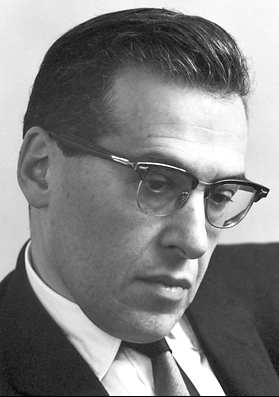
Julian Seymour Schwinger, February 12, 1918 – July 16, 1994.[He was born and raised in New York City and received his PhD in physics at the age of 21. His intense interest of physics and mathematics lead to a highly acclaimed career in theoretical physics. In 1965 he shared the Nobel Prize in Physics with Richard Feynman and Shin’ichirō Tomonaga for their fundamental work in quantum electrodynamics (QED).
Beyond being a physics professor at Harvard Univ, from 1945 to 1974, and from 1972 to 1988 at UCLA, he’s responsible for much of modern quantum field theory. He developed the first electroweak model, the variational approach, the perturbation theory, the equations of motion for quantum fields. the theory of multiple neutrinos, the first example of confinement in 1+1 dimensions, and the theory of the spin-3/2 field.
Schwinger and Feynman
(Content from Wikipedia) As a famous physicist, Schwinger was often compared to another legendary physicist of his generation, Richard Feynman. Schwinger was more formally inclined and favored symbolic manipulations in quantum field theory. He worked with local field operators, and found relations between them, and he felt that physicists should understand the algebra of local fields, no matter how paradoxical it was. By contrast, Feynman was more intuitive, believing that the physics could be extracted entirely from the Feynman diagrams, which gave a particle picture. Schwinger commented on Feynman diagrams in the following way,
Like the silicon chips of more recent years, the Feynman diagram was bringing computation to the masses.[19][20]
Schwinger disliked Feynman diagrams because he felt that they made the student focus on the particles and forget about local fields, which in his view inhibited understanding. He went so far as to ban them altogether from his class, although he understood them perfectly well. The true difference is however deeper, and it was expressed by Schwinger in the following passage,
Eventually, these ideas led to Lagrangian or action formulations of quantum mechanics, appearing in two distinct but related forms, which I distinguish as differential and integral. The latter, spearheaded by Feynman has had all the press coverage, but I continue to believe that the differential viewpoint is more general, more elegant, more useful.[21]
Despite sharing the Nobel Prize, Schwinger and Feynman had a different approach to quantum electrodynamics and to quantum field theory in general. Feynman used a regulator, while Schwinger was able to formally renormalize to one loop without an explicit regulator. Schwinger believed in the formalism of local fields, while Feynman had faith in the particle paths. They followed each other’s work closely, and each respected the other. On Feynman’s death, Schwinger described him as
An honest man, the outstanding intuitionist of our age, and a prime example of what may lie in store for anyone who dares to follow the beat of a different drum.[22]
Another short excerpt from a Wikipedia article goes into great detail about his quantum action principle;
Schwinger’s quantum action principle is a variational approach to quantum mechanics and quantum field theory.[1][2] This theory was introduced by Julian Schwinger in a series of articles starting 1950.[3]
Approach
In Schwinger’s approach, the action principle is targeted towards quantum mechanics. The action becomes a quantum action, i.e. an operator.S Although it is superficially different from the path integral formulation where the action is a classical function, the modern formulation of the two formalisms are identical.[4]
Other notable Wikipedia links:
https://en.wikipedia.org/wiki/Julian_Schwinger
https://en.wikipedia.org/wiki/Quantum_electrodynamics
https://en.wikipedia.org/wiki/Quantum_tunnelling
https://en.wikipedia.org/wiki/Schwinger%E2%80%93Dyson_equation
https://en.wikipedia.org/wiki/Source_field
https://en.wikipedia.org/wiki/Sonoluminescence
https://en.wikipedia.org/wiki/Anomalous_magnetic_dipole_moment
Julian Schwinger developed Source Theory in 1966 as a “phenomenological” alternative to standard quantum field theory (phenomenology: a philosophical movement that describes the formal structure of the object’s awareness and of awareness itself, in abstraction from any claims concerning existence). This line of reasoning became a major part of Schwinger’s work. His approach to describe particle actions expanded into the unexplainable. His Source Theory uses mathematical statements regarding strong interactions without the divergences and renormalization issues of operator-based approaches. His theory proposes “quantum fields as long-distance phenomena and uses auxiliary sources to abstract the creation and annihilation of particles, allowing for calculations that are mathematically consistent and free from infinities.”
From one of the Wikipedia links: Despite its conceptual clarity and ability to derive results like the Casimir effect without zero-point energy, Source Theory failed to gain widespread acceptance. Critics, including colleagues at Harvard, viewed it as an unnecessary complication or a mere pedagogical variant of existing field theories, leading Schwinger to leave Harvard for UCLA in 1972. His three-volume exposition, Particles, Sources, and Fields, remains a comprehensive but largely isolated contribution to theoretical physics.
Why is Schwinger’s name added to this list regarding gravity? Julian Schwinger spent his entire life studying mathematics and theoretical physics, studying and working in the same circles with Paul Dirac, Wolfgang Pauli, Eugene Wigner, Pascual Jordan, Werner Heisenberg, Enrico Fermi, and Robert Oppenheimer.
Schwinger’s work grew from the conformity of opinion amongst academia’s greatest physicists, to the definition of his Renormalization Theory: the replacement of theoretically infinite variables (such as the mass and charge of an electron) with experimentally obtained values in the solutions of equations in certain quantum mechanical theories (such as quantum electrodynamics).
It’s like saying spending his entire life, exploring and calculating the minute details of splitting atoms, there was something more to the reactions.
There is simplicity in nature. Schwinger’s Source Theory holds more than what is academically popular.
Leave a Reply