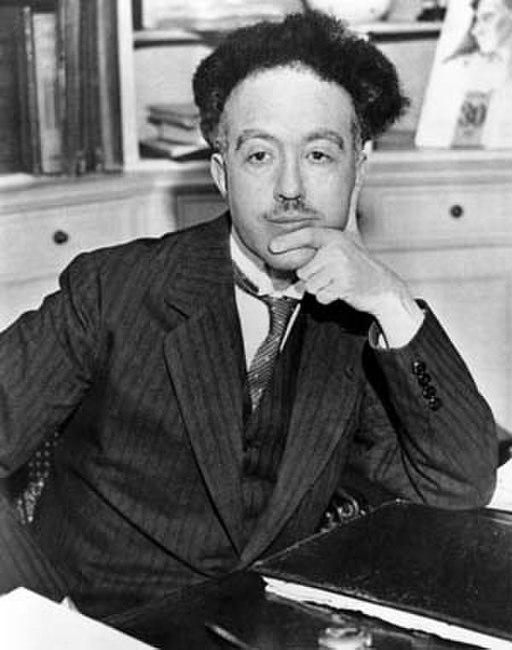
Famous for the de Broglie wave, also known as a ‘matter wave’, is French nobility physicist; Louis de Broglie, full name: Louis-Victor-Pierre-Raymond, 7th duc de Broglie (1892-1987).
In 1924 his thesis for discovering the wave character of matter was awarded the Nobel prize.
Louis de Broglie’s most famous contribution to physics is the de Broglie hypothesis (also called matter waves), proposed in his 1924 PhD thesis Recherches sur la théorie des quanta. It states that all matter has wave-like properties, with a wavelength given by λ = h/p (where h is Planck’s constant and p is momentum). This extended the wave-particle duality of light to material particles like electrons, laying the foundation for wave mechanics and quantum mechanics.
The hypothesis was experimentally confirmed in 1927 by the Davisson–Germer experiment, and de Broglie was awarded the 1929 Nobel Prize in Physics “for his discovery of the wave nature of electrons.”
The best summary about the life of Louis de Broglie and the development of his career which led to his discovery that led to him receiving the Noble Prize in physics is at Britannica.com. The article details his life and how he discovered wave duality.
The CATTCC article titled: de Broglie waves, describes these wave principles.
In another CATTCC article is a paragraph title, Levitating vehicle; which asks a relevant question: What are all the possible aspects involved with levitation? First is electromagnetics. Then, electrogravitics, gravitational influence, psychokinetics, vacuums, CSEs, crystals, polymerization, the Schumann resonance, magnetosphere, ions, chitin, de Broglie waves, mass frequency vibration, dimensional transfer and then whatever else can be found.
Included in the article is a reference to de Broglie waves. What makes de Broglie waves important in theoretical physics is wave duality: the patterning of subatomic wave motion. Again, a reference to the same article is a quote from a collaboration between Viktor Grebennikov and Valery Zolotariov, PhD, about the relationship of the Cavity Structures Effect (CSE) and living systems; “… in which de Broglie waves associated with motion of electron flows in the solid walls of cavities create…”.
The de Broglie waves are universal; they are not isolated nor unique.
A very interesting note at the end of the Britannica article about Louis de Broglie, all of his life’s work brought a similar conclusion as Julian Schwinger: For about three decades after his work of 1923, de Broglie held the view that underlying causes could not be delineated in a final sense, but, with the passing of time, he returned to his earlier belief that the statistical theories hide “a completely determined and ascertainable reality behind variables which elude our experimental techniques.”
His determination; that particles behave in a manner which eludes experimental techniques, corresponds to this new theory which postulates gravity as the angular momentum of particle mass as it rotates along its linear path at light speed.
Leave a Reply